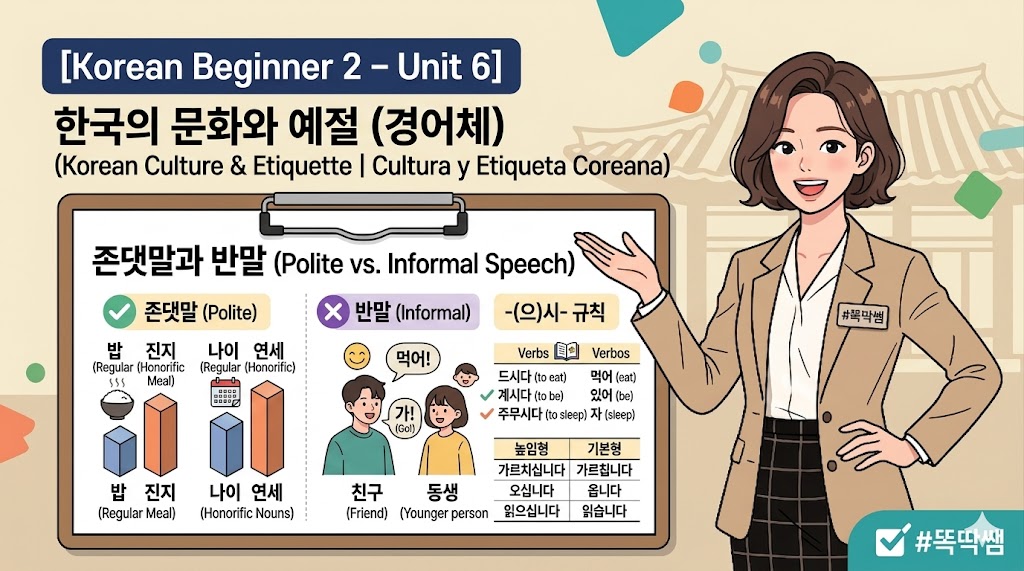
🇰🇷 [Korean Beginner 2 – Unit 6] 한국의 문화와 예절 (경어체) | Korean Culture & Etiquette (Honorifics) | Cultura y Etiqueta Coreana (Honoríficos)
🎯 학습 목표 | Learning Goals | Objetivos de Aprendizaje
한국 문화에서 경어체가 왜 중요한지 이해할 수 있다. Understand why honorifics are important in Korean culture. Comprender por qué los honoríficos son importantes en la cultura coreana.
상황에 맞는 경어체 표현을 올바르게 사용할 수 있다. Use the correct honorific expressions depending on the situation. Usar las expresiones honoríficas correctas según la situación.
일상 대화에서 존중을 담은 자연스러운 한국어를 말할 수 있다. Speak natural, respectful Korean in everyday conversations. Hablar coreano natural y respetuoso en conversaciones cotidianas.
1️⃣ 핵심 개념 | Key Concept | Concepto Clave
경어체란? | What Are Honorifics? | ¿Qué son los Honoríficos?
한국어에는 말하는 상대방의 나이, 사회적 지위, 친밀도에 따라 말투를 달리하는 경어 체계가 있어요. Korean has a honorific system where the way you speak changes depending on the listener's age, social status, and closeness. El coreano tiene un sistema honorífico donde la forma de hablar cambia según la edad, el estatus social y la cercanía del oyente.
💡 영어와 비교 | Compare with English | Comparación con el Inglés 영어에도 "Could you please~?" 처럼 격식체 표현이 있죠? 한국어는 이 차이가 훨씬 더 체계적이에요! English also has formal expressions like "Could you please~?" Korean makes this distinction much more systematically! ¡El inglés también tiene expresiones formales como "Could you please~?" El coreano hace esta distinción de forma mucho más sistemática.
💡 스페인어와 비교 | Compare with Spanish | Comparación con el Español 스페인어의 "tú(너)"와 "usted(당신)" 차이처럼, 한국어도 상대에 따라 말투가 완전히 달라져요! Just like the difference between "tú" and "usted" in Spanish, Korean speech style changes completely depending on who you're talking to! ¡Al igual que la diferencia entre "tú" y "usted" en español, el estilo del habla coreana cambia completamente según con quién hablas!
📌 말투의 3가지 종류 | 3 Types of Speech Styles | 3 Tipos de Estilos de Habla
| 말투 종류 | 상황 (Korean) | Style / Estilo | Situation / Situación | 예시 / Example / Ejemplo |
| 반말 | 친한 친구, 나이 어린 사람 | Informal | Close friends, younger people / Amigos cercanos, personas menores | 밥 먹었어? |
| 존댓말 | 처음 만난 사람, 어른, 직장 상사 | Polite | Strangers, elders, boss / Desconocidos, mayores, jefe | 밥 드셨어요? |
| 격식체 | 공식적인 자리, 발표, 방송 | Formal | Formal settings, presentations / Entornos formales, presentaciones | 식사하셨습니까? |
2️⃣ 높임 표현 핵심 문법 | Key Honorific Grammar | Gramática Honorífica Clave
① 동사에 -(으)시- 붙이기 | Attach -(으)시- to Verbs | Añadir -(으)시- a los Verbos
| 기본형 (Korean) | 높임형 (Korean) | English | Spanish |
| 먹다 | 드시다 / 잡수시다 | to eat (honorific) | comer (honorífico) |
| 자다 | 주무시다 | to sleep (honorific) | dormir (honorífico) |
| 있다 | 계시다 | to be (honorific) | estar (honorífico) |
| 말하다 | 말씀하시다 | to speak (honorific) | hablar (honorífico) |
| 오다 | 오시다 | to come (honorific) | venir (honorífico) |
| 가다 | 가시다 | to go (honorific) | ir (honorífico) |
| 죽다 | 돌아가시다 | to pass away (honorific) | fallecer (honorífico) |
② 높임 명사 | Honorific Nouns | Sustantivos Honoríficos
| 일반 명사 (Korean) | 높임 명사 (Korean) | English | Spanish |
| 밥 | 진지 | meal (honorific) | comida (honorífico) |
| 말 | 말씀 | words (honorific) | palabras (honorífico) |
| 나이 | 연세 | age (honorific) | edad (honorífico) |
| 이름 | 성함 | name (honorific) | nombre (honorífico) |
| 집 | 댁 | house (honorific) | casa (honorífico) |
| 생일 | 생신 | birthday (honorific) | cumpleaños (honorífico) |
3️⃣ 자주 쓰는 경어체 문장 | Useful Honorific Phrases | Frases Honoríficas Útiles
| 한국어 (Korean) | English | Spanish |
| 성함이 어떻게 되세요? | What is your name? (polite) | ¿Cómo se llama usted? |
| 연세가 어떻게 되세요? | How old are you? (polite) | ¿Cuántos años tiene usted? |
| 어디에 사세요? | Where do you live? (polite) | ¿Dónde vive usted? |
| 진지 드셨어요? | Have you eaten? (polite) | ¿Ha comido usted? |
| 천천히 말씀해 주시겠어요? | Could you speak slowly, please? | ¿Podría hablar más despacio? |
| 어디에서 오셨어요? | Where are you from? (polite) | ¿De dónde es usted? |
| 잘 부탁드립니다. | I look forward to working with you. | Me pongo en sus manos. |
| 죄송합니다. | I'm sorry. (polite) | Lo siento mucho. |
| 감사합니다. | Thank you. (polite) | Muchas gracias. |
| 실례합니다. | Excuse me. (polite) | Disculpe usted. |
4️⃣ 실전 대화 연습 | Real-Life Dialogue Practice | Práctica de Diálogo Real
혼자 공부한다면 A와 B 역할을 모두 소리 내어 읽어보세요! If you're studying alone, read both roles aloud! ¡Si estudias solo, lee en voz alta los dos roles!
대화 1: 처음 만났을 때 | First Meeting | Primera Reunión
👤 A: 안녕하세요! 처음 뵙겠습니다. (Hello! Nice to meet you for the first time.) (¡Hola! Es un placer conocerle por primera vez.)
👤 B: 네, 안녕하세요! 성함이 어떻게 되세요? (Hello! What is your name?) (¡Hola! ¿Cómo se llama usted?)
👤 A: 저는 에밀리아예요. 실례지만, 연세가 어떻게 되세요? (I'm Emilia. Excuse me, how old are you?) (Soy Emilia. Disculpe, ¿cuántos años tiene usted?)
👤 B: 저는 서른다섯 살이에요. (I'm 35 years old.) (Tengo 35 años.)
👤 A: 아, 그렇군요! 잘 부탁드립니다. (Oh, I see! I look forward to getting to know you.) (¡Ah, ya veo! Me pongo en sus manos.)
대화 2: 직장에서 | At the Workplace | En el Trabajo
👤 직원 (Employee / Empleado): 김 부장님, 진지 드셨어요? (Manager Kim, have you had lunch?) (Director Kim, ¿ha comido usted?)
👤 부장 (Manager / Director): 네, 방금 먹었어요. 이 대리님은요? (Yes, I just ate. How about you, Assistant Manager Lee?) (Sí, acabo de comer. ¿Y usted, Subdirector Lee?)
👤 직원: 저도 먹었습니다. 오늘 회의가 몇 시예요? (I ate too. What time is the meeting today?) (Yo también comí. ¿A qué hora es la reunión hoy?)
👤 부장: 오후 두 시예요. 준비해 주세요. (It's at 2 PM. Please get ready.) (Es a las 2 de la tarde. Por favor, prepárese.)
대화 3: 어른께 길 물어보기 | Asking an Elder for Directions | Pedir Indicaciones a una Persona Mayor
👤 젊은이 (Young person / Joven): 실례합니다, 어르신. 지하철역이 어디에 있는지 아세요? (Excuse me, sir/ma'am. Do you know where the subway station is?) (Disculpe, señor/señora. ¿Sabe dónde está la estación de metro?)
👤 어르신 (Elder / Persona mayor): 네, 저 사거리에서 오른쪽으로 가시면 돼요. (Yes, go right at that intersection.) (Sí, gire a la derecha en ese cruce.)
👤 젊은이: 감사합니다! 정말 감사드립니다. (Thank you! I'm truly grateful.) (¡Gracias! Le estoy muy agradecido/a.)
🌏 문화 팁 | Culture Tip | Consejo Cultural
🙇 인사 문화 | Bowing Culture | Cultura de las Reverencias
| 인사 각도 / Degree / Grados | 상황 (Korean) | Situation (English) | Situación (Spanish) |
| 15도 | 가벼운 인사 | Casual greeting | Saludo casual |
| 30도 | 일반적인 인사 | General greeting | Saludo general |
| 45도 | 깊은 존경 표시 | Deep respect | Profundo respeto |
🤲 두 손 사용 | Using Two Hands | Usar Dos Manos 물건을 주거나 받을 때, 악수할 때 두 손을 사용하면 더 예의 바르게 보여요. Using two hands when giving or receiving items, or shaking hands, is considered more respectful. Usar dos manos al dar o recibir objetos, o al estrechar la mano, se considera más respetuoso.
🍽️ 식사 예절 | Dining Etiquette | Etiqueta en la Mesa 어른이 먼저 식사를 시작해야 다른 사람들도 먹기 시작해요. Wait for the eldest person to start eating before you begin. Espera a que la persona mayor empiece a comer antes de comenzar tú.
🚌 자리 양보 | Giving Up Seats | Ceder el Asiento 대중교통에서 어른께 자리를 양보하는 것은 기본 예의예요. Giving up your seat for elders on public transportation is basic etiquette. Ceder el asiento a las personas mayores en el transporte público es una etiqueta básica.
✏️ 연습 문제 | Practice Exercises | Ejercicios de Práctica
먼저 스스로 풀어보고, 아래 정답과 비교해 보세요! Try answering on your own first, then check the answers below! ¡Intenta responder por tu cuenta primero y luego comprueba las respuestas!
연습 1. 다음 문장을 경어체로 바꾸세요. Change the following sentences into honorific form. Cambia las siguientes oraciones a la forma honorífica.
① 이름이 뭐예요? → ___________________________
② 밥 먹었어요? → ___________________________
③ 어디에 살아요? → ___________________________
④ 나이가 몇 살이에요? → ___________________________
✅ 정답 | Answers | Respuestas
① 성함이 어떻게 되세요? ② 진지 드셨어요? ③ 어디에 사세요? ④ 연세가 어떻게 되세요?
연습 2. 알맞은 표현을 고르세요. Choose the correct expression. Elige la expresión correcta.
① 친한 친구에게 말할 때 | When talking to a close friend | Al hablar con un amigo cercano
a) 밥 드셨어요? b) 밥 먹었어?
② 직장 상사에게 말할 때 | When talking to your boss | Al hablar con tu jefe
a) 어디 가? b) 어디 가세요?
③ 처음 만난 어른에게 말할 때 | When meeting an elder for the first time | Al conocer a una persona mayor
a) 이름이 뭐예요? b) 성함이 어떻게 되세요?
④ 어른께 감사 인사를 할 때 | When thanking an elder | Al agradecer a una persona mayor
a) 고마워요. b) 감사합니다.
✅ 정답 | Answers | Respuestas
① b) ② b) ③ b) ④ b)
연습 3. 빈칸에 알맞은 높임 명사를 넣으세요. Fill in the blanks with the correct honorific noun. Rellena los espacios con el sustantivo honorífico correcto.
보기 | Word bank | Banco de palabras: 진지 / 성함 / 연세 / 말씀 / 댁
① 어르신, ____________이 어떻게 되세요? (name / nombre) ② 할아버지, ____________ 드세요. (meal / comida) ③ 선생님, ____________이 맞나요? (words / palabras) ④ 교수님 ____________이 어디예요? (house / casa) ⑤ 어머니, ____________가 어떻게 되세요? (age / edad)
✅ 정답 | Answers | Respuestas
① 성함 ② 진지 ③ 말씀 ④ 댁 ⑤ 연세
🎯 정리 | Summary | Resumen
오늘은 한국어 경어체의 기본을 배웠습니다. 핵심 내용을 정리해 볼까요? Today we learned the basics of Korean honorifics. Let's review the key points! Hoy aprendimos los fundamentos de los honoríficos coreanos. ¡Repasemos los puntos clave!
| 핵심 내용 (Korean) | English | Spanish |
| 반말 / 존댓말 / 격식체 | Informal / Polite / Formal | Informal / Educado / Formal |
| 동사에 -(으)시- 붙이기 | Attach -(으)시- to verbs | Añadir -(으)시- a verbos |
| 밥→진지 / 나이→연세 | 밥→진지 / 나이→연세 | 밥→진지 / 나이→연세 |
| 나이 한 살 차이도 존댓말! | Even 1 year = polite speech! | ¡Incluso 1 año = habla educada! |
💡 독학 팁 | Self-Study Tip | Consejo de Autoestudio
🎭 역할극 연습하기 | Role Play Practice | Practica el Juego de Roles 오늘 배운 대화를 거울 앞에서 혼자 연습해 보세요. A와 B 역할을 번갈아 하면서 자연스럽게 익히세요! Practice today's dialogues in front of a mirror. Take turns playing both A and B roles to get comfortable! ¡Practica los diálogos de hoy frente a un espejo. Alterna los roles de A y B para sentirte cómodo!
📺 한국 드라마 관찰하기 | Observe K-Dramas | Observa los K-Dramas 드라마에서 등장인물들이 서로 어떤 말투를 사용하는지 관찰해 보세요. 나이와 관계에 따라 말투가 어떻게 달라지는지 확인해 보세요! Watch how characters in Korean dramas speak to each other. Notice how the speech style changes based on age and relationship! ¡Observa cómo hablan los personajes en los dramas coreanos. Fíjate en cómo cambia el estilo según la edad y la relación!
🏷️ 해시태그 | Hashtags